SteelMint Events

Category: Blog

  • Bangladesh banking on coal imports as energy demand soars

    Bangladesh banking on coal imports as energy demand soars

    The ever-growing demand for electricity has increased the reliance on coal globally, especially in emerging economies with underdeveloped renewable energy infrastructures and pressing energy security concerns. Bangladesh is a case in point.

    The country has increased procurement of imported coal in a significant way to make up for domestic scarcity of the fuel. Besides, commissioning of new coal-fired power plants has also pushed up demand for coal.

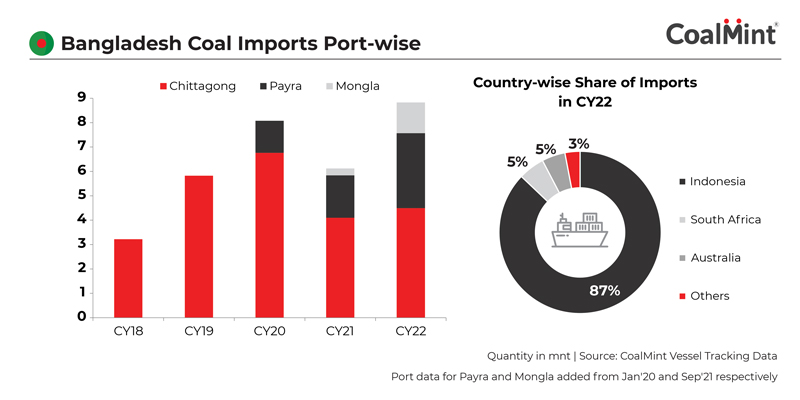
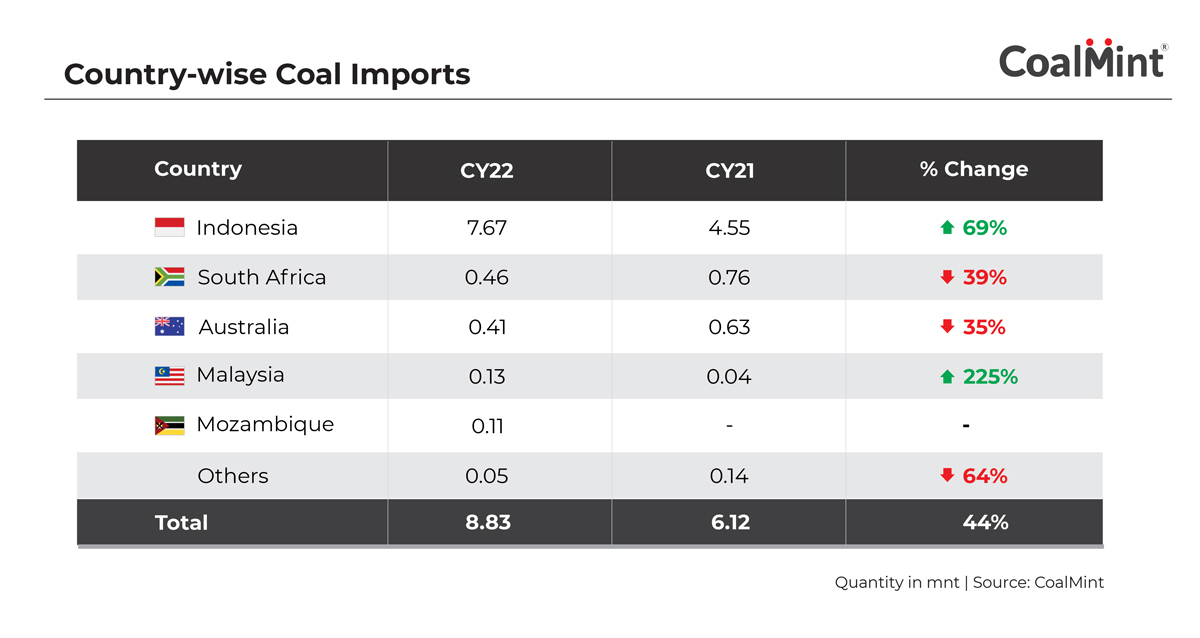
    As per data compiled by CoalMint, the country’s coal imports surged 44% y-o-y to 8.83 million tonnes (mnt) in CY22. Indicating strong demand, the total volume of imports in CY21 was already surpassed during the first 10 months of CY22.

    At the same time, tight supply and high prices of coal in the global market forced Bangladesh to re-work its procurement strategy.

    The sharp growth in imports was mainly driven by higher sourcing from Indonesia in CY22. On the other hand, intake from other traditional markets such as South Africa and Australia plunged 39% and 35%, respectively.
    Inadequate domestic supplies

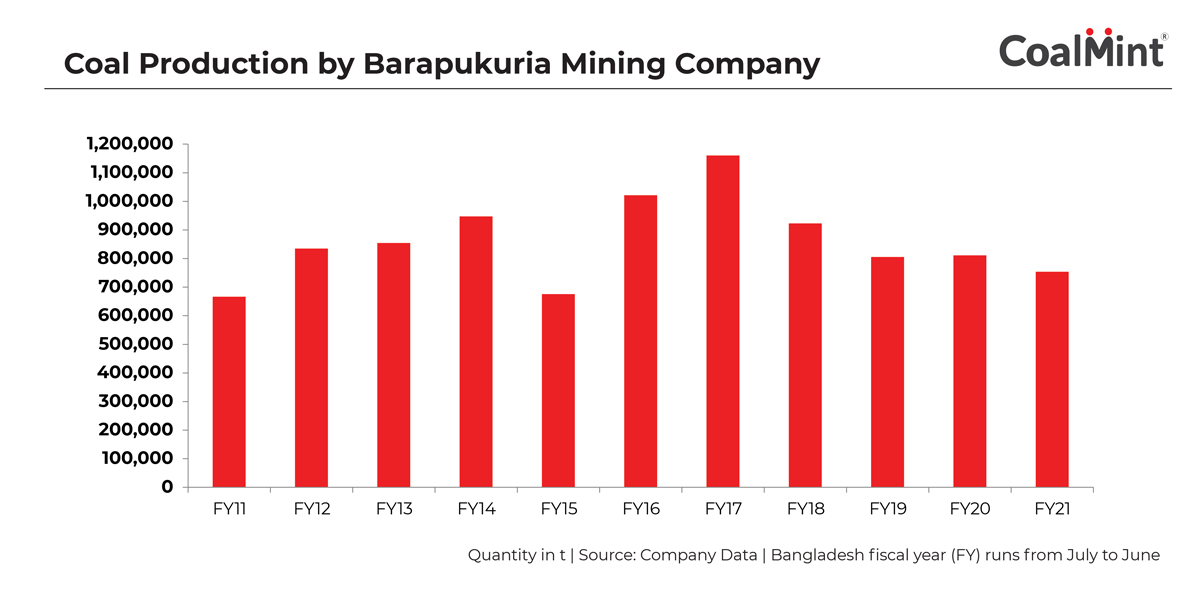
    The Barapukuria Coal Mining Company (BCMCL), operator of the first and sole coal mine in Bangladesh, reported a decrease of 7% in annual coal production in FY21 (July 2020-June 2021). The company recorded 753,973 t of output in FY21 as against 811,137 t in FY20, thus attaining its lowest output in the past six fiscals.
    Given this subdued performance, the company suspended sales to local buyers from 19 March, 2018, in order to secure supplies for the power units of the state-run Bangladesh Power Development Board (BPDB).

    Of the total output, almost the entire volume was delivered to BPDB, while a nominal 610 t was supplied externally during FY21, as per the company’s report.

    In a fresh setback to the fuel security of power plants, the company is mulling to increase its coal pricing to compensate for the upward revision in royalty payable on coal. Moreover, the price hike was also necessitated to adhere to the proposed mining agreement that will require additional land acquisition to extract coal from the northern part of the mine.

    It is important to note that BCMCL has been selling coal at a fixed price of $130/t to BPDB since May 2015.

    Coal: A cheap option

    Due to availability of gas reserves, the gas-based plants in Bangladesh hold a majority share in total power generation capacity.

    Total installed capacity of BPDB-owned plants was 22,482 MW in FY22, of which gas-based plants’ capacity was 11,476 MW, whereas capacity of coal plants stood at a mere 1,768 MW. Plants based on diesel, furnace oil, renewables, etc. made up for the remaining share of power capacity.
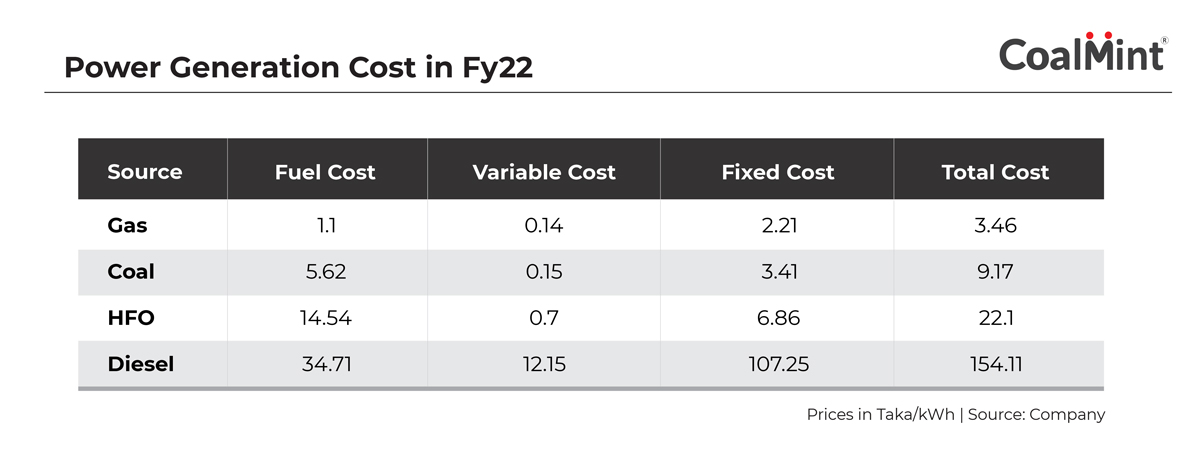
    A comparative cost analysis indicates that gas is the cheapest source of power generation. However, coal was still economical than other

    alternative power sources – another reason for the country’s growing reliance on coal.

    Coal demand accelerates

    Fuelled by the commissioning of the two 660 MW units of the Payra power station, coal imports have started increasing at Payra port, which was established in order to facilitate coal imports for the power sector.

    Meanwhile, at least six other coal-fired power projects are expected to be commissioned, three of which, with a total capacity of 2,800 MW, are expected to be completed soon.

    As per a study by the International Energy Agency (IEA), coal consumption in Bangladesh declined by 0.8 mnt to 3.8 mnt in CY21 but is expected to grow by 2.8 mnt in CY22.

    The report suggests that the country’s coal power fleet would increase to around 5,000 MW by CY25, boosting annual coal demand to 19 mnt.

    2nd Asia Coal Outlook & Trade Summit

    Is Bangladesh’s energy security at a crossroads with the withdrawal of foreign investments from the country’s power sector? Does the country share this predicament with other emerging economies in Asia that are grappling with energy security concerns amid global inflation and depleting investments in coal-based assets? Want to be a part of the discussion? Check out registration details for CoalMint’s 2nd Asia Coal Outlook & Trade Summit to be held at Grand Hyatt Erawan in Bangkok, Thailand on 24-25 April, 2023.

  • CIL sets production record but supplies still tight for non-power sector

    CIL sets production record but supplies still tight for non-power sector

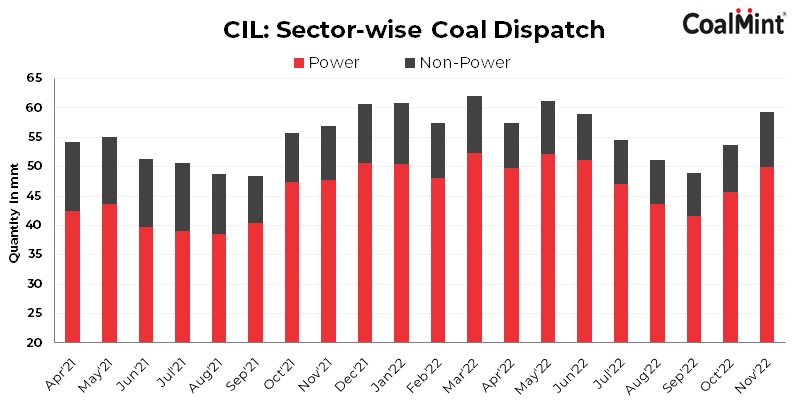
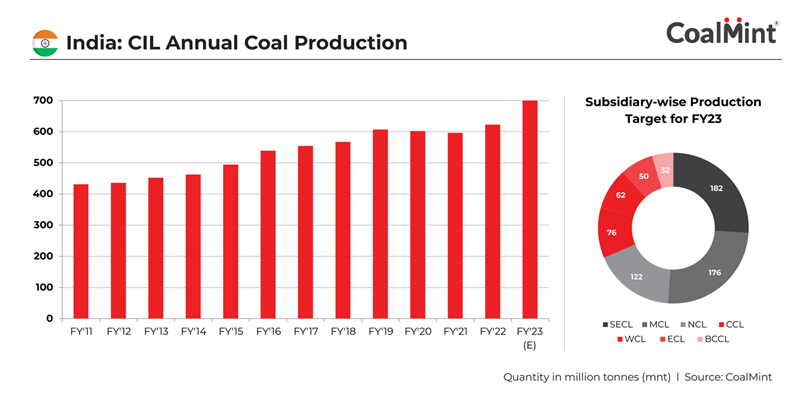
    State-run miner Coal India Ltd. (CIL) has attained new highs in terms of coal production. The company breached the 400-million tonnes (mnt) production mark in the quickest time since its inception. The milestone was attained on 24 November of the ongoing fiscal, 31 days ahead compared to 25 December of last year.

    During April-November 2022, total production reached 412.6 mnt, up 17% y-o-y. The company is striding towards its target of 700 mnt set for FY23, which will be a new production milestone.

    Turning the tides in its favour, the company registered higher sales to keep pace with robust demand which helped it to deliver consolidated profit after tax of INR 14,878 crore in H1FY23 – the highest ever recorded during H1 of any fiscal so far.

    With demand for coal showing no signs of slowing down in the near term, the introduction of latest policy reforms is likely to further boost price realisation from coal sales.

    However, despite the increase in production is CIL being able to cater to all segments of coal consumers?

    Premium on coal supplies

    CIL has decided to charge a premium of 40% over the notified price across the entire range of coal grades supplied under bridge linkage.

    This provision refers to temporary coal supply till the time an end-user company commences operations from an allocated coal mine. This price structure is applicable for existing as well future contracts for both power and non-power customers from 1 June, 2022.

    Similar facility has been kept for coal supplied under flexi utilisation policy, which was the introduced to transfer coal linkages of one power station to another for reducing the cost of power generation.

    However, this revision would be applicable specifically for the thermal power plants lifting coal against this policy that do not have fuel supply agreement (FSA) with individual CIL subsidiaries effective from 22 November, 2022.

     Challenges confronting non-power sector  

    The CIL board has decided not to renew long-term contracts for coal supplies under linkage auctions meant for the non-power sector.

    These auctions are held across various tranches for different sub-sectors namely sponge iron, cement, captive power, steel and others. Till date, five tranches of auctions have been successfully conducted.

    As per policy guidelines, the tenure of FSA against these auctions was five years, which was initially proposed for extension for another five years upon mutual agreement.

    However, the company has informed that the expiring FSA contracts under tranches II and III auctions held during January-November, 2017 would not be renewed beyond five years. Similar instruction was also issued in case of contracts under tranche-I auctions.

    The decision has come as a big blow to the non-power customers who are already facing supply tightness amid CIL’s disparity in coal allocation.

    In a latest development, CIL has come-up with sixth tranche of auctions starting with sales for sponge iron sector in the first phase from 23 December. It is expected that these auctions would witness aggressive procurement as customers will look to secure fresh supplies against their expiring contracts by placing higher bids for the coal being offered.

    The Standard Linkage Committee has decided not to extend nomination-based coal linkage supplies to the thermal power plants that are executed under Letter of Assurance (LOA) route beyond 31 March, 2022.

    This indicates that the power producers would now have to secure coal linkages via competitive bidding under various auctions marked under SHAKTI (Scheme to Harness and Allocate Koyla Transparently in India) policy, instead of procuring coal at fixed notified price in the previous regime.

     Single window auction 

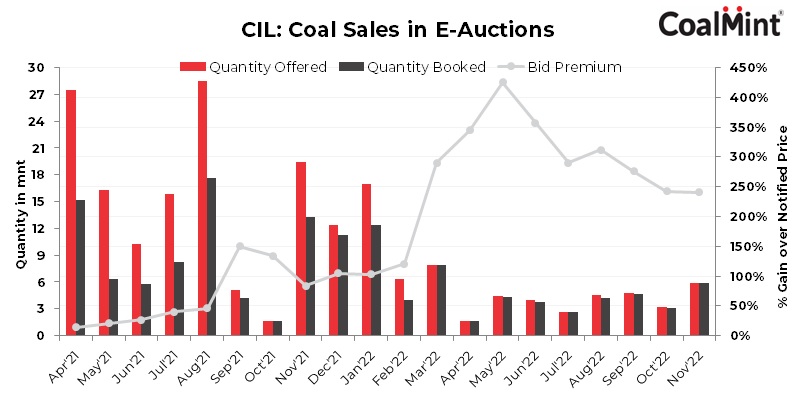
    Apart from FSA contracts, CIL’s coal sales via regular auctions has been the bright spot led by the spurt in bid prices as the buyers are aggressively procuring the limited material put up on sale.

    This comes after the company’s supply prioritisation for the power sector had resulted in drastic curtailment of material offered at auctions.

    The new scheme has ensured a uniform rate for all consumers, thus making the gradual shift from the price discrepancy-based system that was adopted earlier. Besides, it also eliminated the variation seen in allocating coal for sale to different sets of consumers. Wider participation helped CIL to fetch better premiums.

    During April-November 2022, sales via auctions garnered a premium of 308% over the average notified price assessed for the allocated coal grades as against 50% recorded in April-November, 2021.

    CIL has developed a new scheme for conducting coal sales under the auction route by the introduction of a two-stage bidding process.

    The new policy is still under development stage with Eastern Coalfields being the sole subsidiary to have implemented it so far. However, the proceedings of the auction suggest that it will promote competitive bidding amongst the participants for preferential loading points.

     2nd Asia Coal Outlook & Trade Summit 2023  

    CIL has increased production rapidly over the last decade, but is it being able to cater to all segments of coal consumers in India? The non-power sector is facing a supply crunch and buyers don’t have enough material to bid for at CIL auctions. What steps may CIL and the larger policy establishment take to implement import substitution more effectively in India? Sign in for CoalMint’s 2nd Asia Coal Outlook & Trade Summit 2023 to be held in Bangkok, Thailand, on 24-25 April, 2023, where experts will discuss these issues threadbare.


  • How might Asian coal trade dynamics change if China lifts ban on Australian coal?

    How might Asian coal trade dynamics change if China lifts ban on Australian coal?

    Australia’s Foreign Minister Penny Wong met with her Chinese counterpart Wang Yi in Beijing on 21 December, 2022, as the trading partners seek to stabilise their diplomatic relationship. Wong’s visit is the first by an Australian minister since 2019 and the first formal talks in Beijing since 2018.

    It is widely expected that a thaw in the bilateral relationship will have a positive outcome for trade. If market chatter is anything to go by, the possibility of China lifting its informal embargo on a host of Australian exports, most prominently coking coal, is by no means remote.

    China had levied an informal ban on its top coal sourcing destination in the latter half of 2020 as tensions escalated between the two trading partners over a series of issues. China was one of the leading coal importers from Australia till 2019 with the latter exporting about 25% of its total coal (both thermal and coking) exports to China.
    As relations between the two countries are heard to be improving, speculation is rife that coal trade might resume once again.

    China-Australia trade dynamics: how it changed?

    Australia accounts for 58% of global seaborne trade in metallurgical coal, while China, the world’s largest steelmaking hub, accounts for 55% of global steel production.

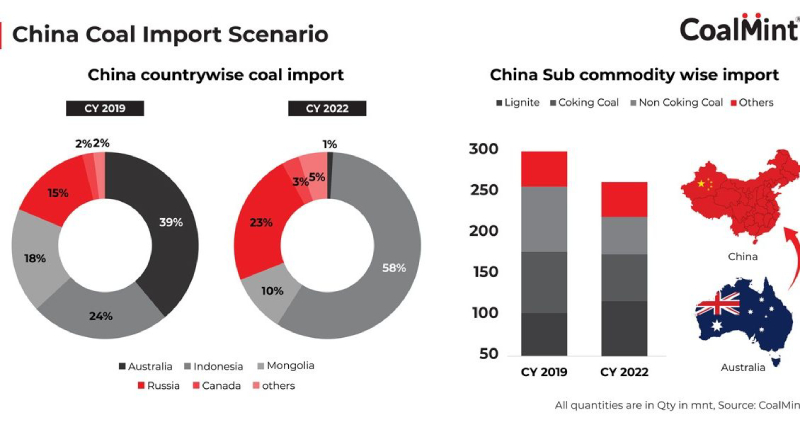
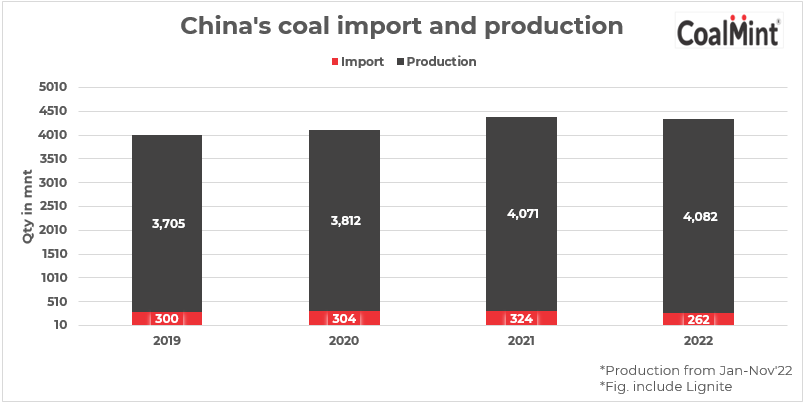
    China imported 197 million tonnes (mnt) of coal in 2019 (before the informal ban), of which 40% was imported from Australia. Commodity-wise, Australia’s share in China’s coking coal imports stood at 40%, while for thermal coal it was 60%.

    Post 2020, China focused on increasing its domestic coal production. Compared to 2019, China’s domestic coal production jumped 20% to 4,452 mnt in 2022.

    While imports continue to arrive in China, the absence of Australian cargoes has been filled by met coal imports from the US, Canada and Russia. For thermal coal, imports from Indonesia, Russia and Colombia increased substantially.

    Interestingly, the share of Russian coal in Chinese imports increased noticeably after the Russia-Ukraine war earlier this year and subsequent sanctions imposed by European countries.

    Russia’s share in China’s total coal imports have gone up to 22% this year against 10% in 2019 and 12% in 2022. Chinese buyers favour Russian coal for its high quality and low prices.

    What might happen if China-Australia trade resumes?

    As per CoalMint analysis, even if trade resumes between the two countries the situation is unlikely to revert to what it was in 2019.

    This is because the Russia-Ukraine war has changed global coal trade flows. With sanctions on Russia by a majority of western countries and a few Asian ones too, Russian coal is being diverted to China at much cheaper rates.

    On the other hand, Australian coal has found favour in key economies such as Europe, Japan, and South Korea. This has resulted in Australian coking and thermal coal prices trending at high levels. Australian thermal coal prices are still elevated by about 24% as against January this year.

    While global steel and thermal coal demand remains slow at present due to Covid and recessionary pressure, in the long run if Australian coal miners are hoping for Chinese buyers to make a return to the market, their hopes are likely to be dashed. Given the fact that Australian coal is massively uncompetitive against its rivals coupled with the fact that China is raising its domestic output, it is uncertain whether Australian coal exports to China will resume in a big way.

    Asia Coal Trade Summit 2023

    Keen to attain insights on Asian coal trade flows and the emerging demand-supply dynamics in the continent? How may China’s coal demand pan out in the near term and what factors are likely to shape met coal trade flows in 2023? Sign in for CoalMint’s Asia Coal Trade Summit to be held at Bangkok, Thailand, in April 2023

  • Karnataka iron ore exports to resume after 10 years

    Karnataka iron ore exports to resume after 10 years

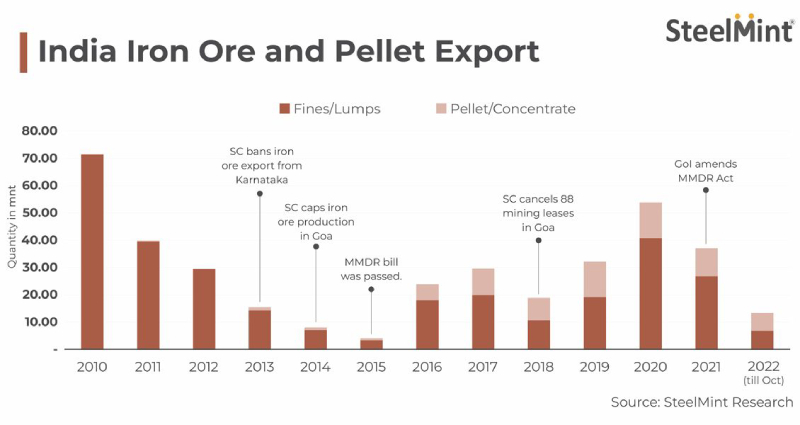
    Iron ore exports from Karnataka are about to resume after a gap of 10 years, SteelMint heard from market sources. Exports from Karnataka were banned in 2012 by the Supreme Court, which was in effect till May this year, with the aim of preventing environmental degradation and to ensure that the mineral resources of the state were preserved for the domestic industry and for future generations as part of the concept of inter-generational equity.

    The Supreme Court on 20 May this year lifted curbs on exports of iron ore from Karnataka and eased all restrictions on sales from the districts of Bellary, Chitradurga and Tumkur where mining activity had been prohibited following rampant environmental transgressions in 2011.

    As per a recent update received by SteelMint, a leading miner in the state is planning to export a capesize vessel of iron ore fines for which the material is already in the process of being transported to Krishnapatnam Port. Market chatter is revolving around the near-term prospects for iron ore and pellet exports by Karnataka-based miners.

    Factors which may drive exports

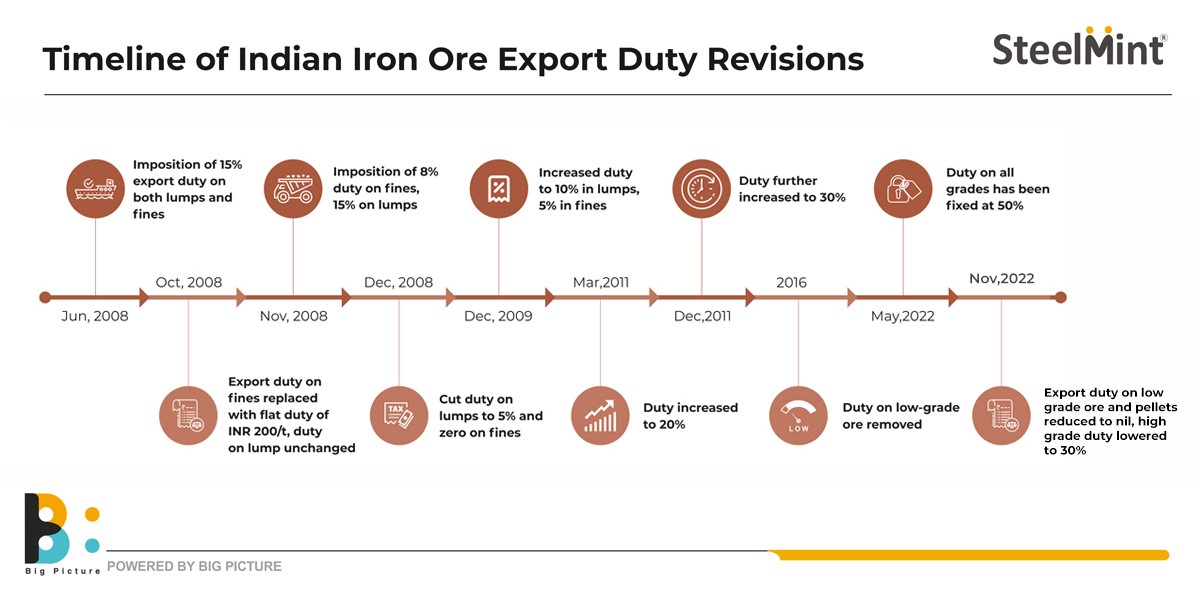
    • Lifting of export curbs: The apex court lifted curbs on iron ore exports and allowed iron ore operators in the state to sell excavated ore through direct sales as against just through e-auctions. This is a win-win for merchant miners and steel companies. By lifting the ban on exports of iron ore, the court opened an avenue for sale of surplus ore, which the industry had been pleading for. Also, the export duties on pellets and iron ore (except high-grade) have been rolled back recently. It should be noted that there is a possibility of existing low-grade iron ore stocks at mine pitheads in the state to come for exports in the short term. These are estimated at around 6 mnt, as per sources. Additionally, some volumes of seized material around 20-30 mnt are yet to be lifted, which may also come up for exports, as per sources. Besides, some small volumes of fines with sponge iron (CDRI) producers in the state might well get earmarked for exports.

    • China demand: After a long lull induced by Covid-related restrictions, the Chinese market is showing some positive sentiments due to the 16-point stimulus package announced by the government for the real estate sector, which accounts for around 35% of China’s steel demand. The possibility of a turnaround in the property sector has been driving iron ore prices higher over the past month, along with loosening of Covid restrictions. A weaker dollar, optimism about China’s economic recovery and positive developments in the real estate sector boosted market sentiment, as iron ore futures on the Dalian Commodity Exchange (DCE) have hit a 6-month high. As global iron ore fines Fe 62% prices have recovered from $80/t in the beginning of November to over $110/t currently, the incentive for exports is always present.
    • Production ramp up: The Supreme Court has raised the iron ore production ceiling in Karnataka from 35 mnt to 50 mnt from the A and B category mines. The production cap in Bellary has been raised to 35 mnt from 28 mnt, while in Chitradurga the ceiling has been raised to 15 mnt from the erstwhile 7 mnt. Therefore, the total cap has been increased to 50 mnt. The apex court had lifted the five-year-old ceiling on production from 30 mnt to 35 mnt for A and B category mines in 2018. There was no cap on the C category mines. It has been generally observed that total iron ore demand in the state stands at around 38 mnt annually. Therefore, following the possible production ramp up in the state, there is always the possibility that surplus material would be left for exports.

    Karnataka road show

    How is Karnataka’s iron ore and pellet industry shaping up post SC verdict? What is the potential in terms of production, demand, exports, and sales? Are you an industry stakeholder keen to find answers to these and several other queries? Book your seat at SteelMint’s Road Show-cum-Conference on Karnataka’s Mining Sector to be held on 19-21 January, 2023.

  • Karnataka may add up to 9 mnt iron pellet capacities in next few years

    Karnataka may add up to 9 mnt iron pellet capacities in next few years

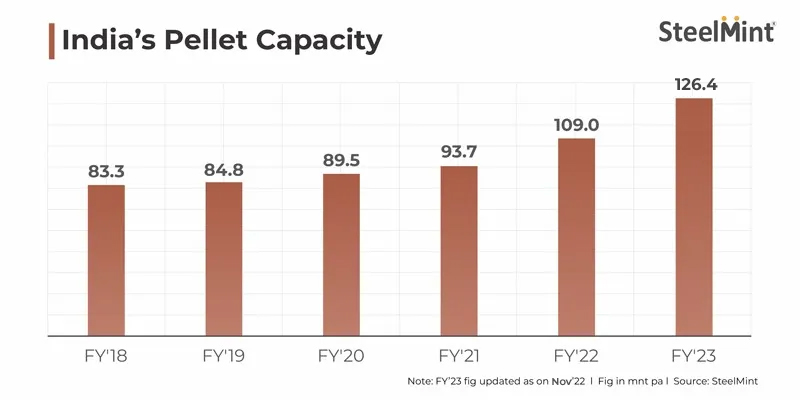
    India’s pellet-making capacity has expanded rapidly in recent years along with the steady rise in crude steelmaking capacity. SteelMint estimates that the country’s pellet production capacity currently stands at 126 million tonnes (mnt), which is 16% higher than 109 mnt in FY22.

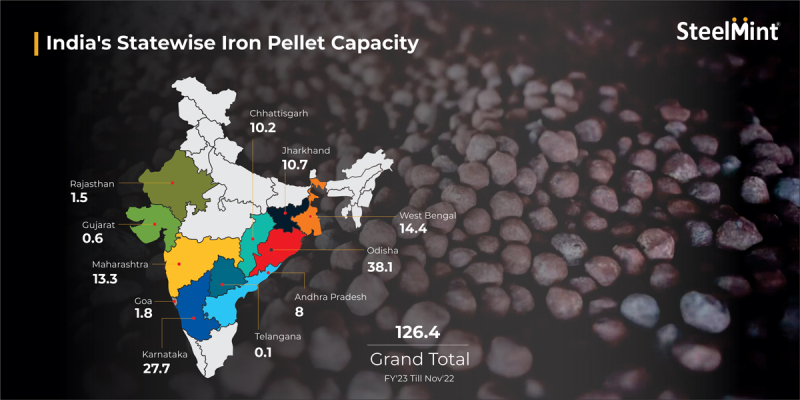
    Karnataka’s share in India’s total pellet capacity is around 21% at 27.7 mnt currently. It has the second-largest pellet production capacity among Indian states, with Odisha topping the list at over 38 mnt. Karnataka emerged as the second-largest iron ore producing state in India in FY22 with production of about 40 mnt – roughly 16% of the country’s total production.

    Pellet capacity expansion

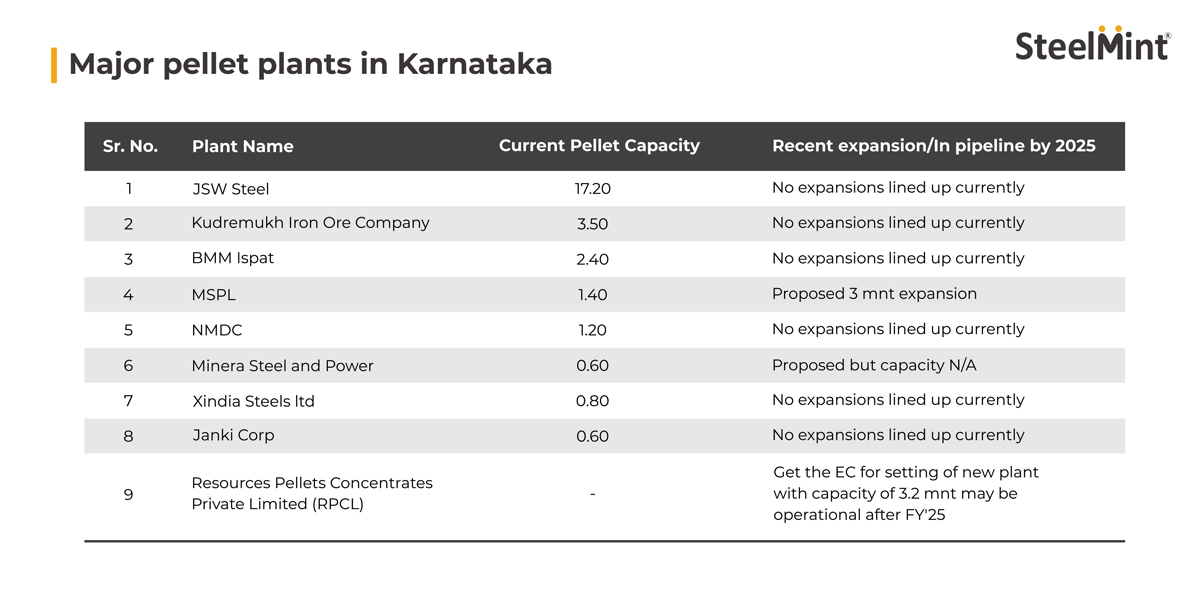
    SteelMint data shows that there are a few pellet capacity expansion projects in the pipeline in Karnataka. These are the following:

    • MSPL is looking to expand its plant capacity to 3 mnt by 2025 from around 1.4 mnt at present.
    • Minera Steel and Power has proposed to raise its pellet capacity. The company’s current capacity is 600,000 t per annum.
    • Vedanta Limited has invited expressions of interest (EoI) from competent Indian and international business partners for establishing a 3 mnt per annum pellet plant in the state supported by captive iron ore supply. The Sesa Goa iron ore mine in Karnataka has an operational capacity of 6 mnt/year.
    • Resources Pellets Concentrates Private Ltd. has received EC for setting up a 3.2 mnt/year pellet plant, which is expected to start operations after 2025.
    • Steel major JSW Steel’s present pellet plant capacity in Vijaynagar is 17.2 mnt. The company increased its capacity by about 8 mnt from 9.2 mnt previously.

    Why are pellet capacities increasing?

    Rising crude steel capacities to boost pellet usage – In conjunction with rising crude steel capacity in India, DRI (sponge iron) production is growing simultaneously. The country’s DRI output, which was a little under 40 mnt in FY22, is expected to rise to 50 mnt by 2030. Likewise, pellet usage in sponge iron production is increasing fast. The share of pellet-based DRI in India has increased to around 65% against 35% for iron ore lump-based sponge iron. One key reason is that iron ore lump availability and deliveries remain tight, and so sponge players are shifting towards pellets for quicker deliveries.

    Lower coke consumption – Use of pellets in blast furnace steelmaking is also gaining traction. This is because increased use of pellets enables permeability in the furnace and seamless gas flow within it, as well as smooth descent of the ferrous burden. This facilitates energy efficiency by way of reduced coke consumption and chemistry control. The primary mills have increased the pellet burden in BF to around 25% at present, which is expected to go up to 30-35% in the coming time, SteelMint estimates. With India’s steelmaking capacity projected to climb to over 250 mnt by 2030 and with production from the BF-BOF route expected to be around 55% of the total at around 140 mnt, pellet usage in primary steelmaking is set to increase.

    Benefits over sinter usage – Pelletisation is a cleaner process than sintering with a substantially reduced carbon footprint. With the massive push for decarbonisation and green steel, India’s targeted 300 mnt/year crude steel capacity by 2030 will have to be supported by pellets. Unlike sinter, pellets give mills the flexibility to handle low-grade ore. Higher grade reserves are getting depleted over time, making sintering costly and less environment friendly.

    Increased iron ore availability in Karnataka post lifting of mining caps – Karnataka’s iron ore production stood at around 40 mnt in FY22, while total demand is estimated at around 35-38 mnt. India’s Supreme Court has raised the iron ore production ceiling in Karnataka from 35 mnt to 50 mnt from the A and B category mines. The production cap in Bellary has been raised to 35 mnt from 28 mnt, while in Chitradurga the ceiling has been raised to 15 mnt from 7 mnt. Going forward, the production cap may be relaxed further ensuring increased supply of ore for pellet production.

    Ease of export restrictions – The Supreme Court has recently lifted curbs on exports of iron ore and pellets from Karnataka and eased restrictions on sales from the districts of Bellary, Chitradurga and Tumkur. This has gone a long way in opening up the market for producers and has given an edge to pellet-makers to enhance capacity in the years to come.

    What may happen?

    India’s crude steelmaking capacity is projected to increase to around 200 mnt by 2025 from around 150 mnt at present, as per SteelMint estimates. Likewise, iron ore demand is estimated to rise to nearly 250 mnt by 2025 from around 200 mnt at present. Therefore, the prospects of pellet capacity expansion in the short term are bright not just in Karnataka but across the country.

    Karnataka Road Show

    How is Karnataka’s iron ore and pellet industry shaping up post SC verdict? What is the potential in terms of production, demand, exports, and sales? Are you an industry stakeholder keen to find answers to these and several other queries? Book your seat at SteelMint’s Road Show-cum-Conference on Karnataka’s Mining Sector to be held on 19-23 January, 2023.