SteelMint Events

Category: Steel Scrap & Recycling

  • Chennai Vehicle Recycling Unit to Start Operations by Q2: Mahindra Accelo

    Chennai Vehicle Recycling Unit to Start Operations by Q2: Mahindra Accelo

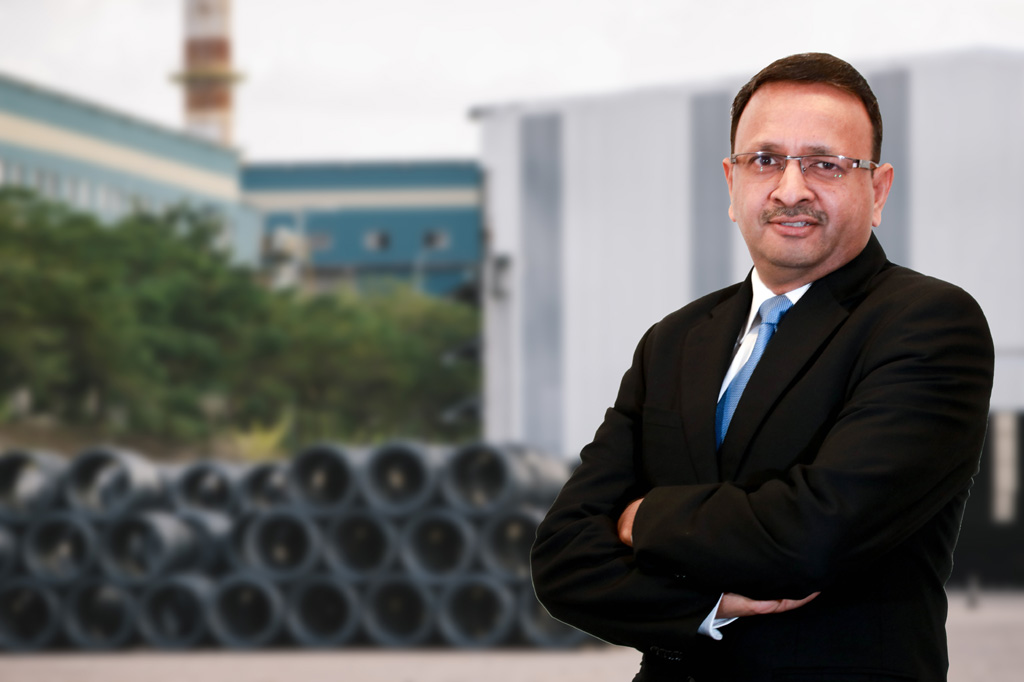
    Vehicle recycling is gaining momentum in India. The country’s first vehicle recycling facility was formed by a joint venture between Mahindra Accelo and MSTC Ltd, a Government of India enterprise. SteelMint, caught up with Mr. Vijay Arora, Vice President, Strategy, Operations and Business Development, Mahindra Group Accelo, India, to learn about his views on the present and future vehicle recycling scenario in India. Below are edited excerpts from the interview:

    1. How do we see the changing scenario in the Auto recycling industry in India? What could be the growth potential of this sector in the coming years?

    Recycling is the need of the hour. Talking about vehicle recycling, almost 50,000 new vehicles are put on Indian roads every day. If we take the average life of a vehicle to be 15 years, there are about 26 million end-of-life vehicles in India currently. And this is expected to increase up to 42 million by 2025.

    These numbers are testimony to the tremendous growth potential and necessity for the recycling industry. The market is showing a positive transition as awareness about the benefits of recycling as well as disadvantages of doing it in an unscientific manner are increasing. Deploying state-of-the-art recycling technologies for sorting waste will further improve recycling.

    Awareness about the fact that ‘traditional recycling methods are not sufficient for quality recycling’ will offer great possibilities in this sector in the coming years. Even the government is taking note of these things.

    2. What are the present developments of Mahindra CERO’s ELV processing facility in Noida which was set up in co-operation with MSTC?

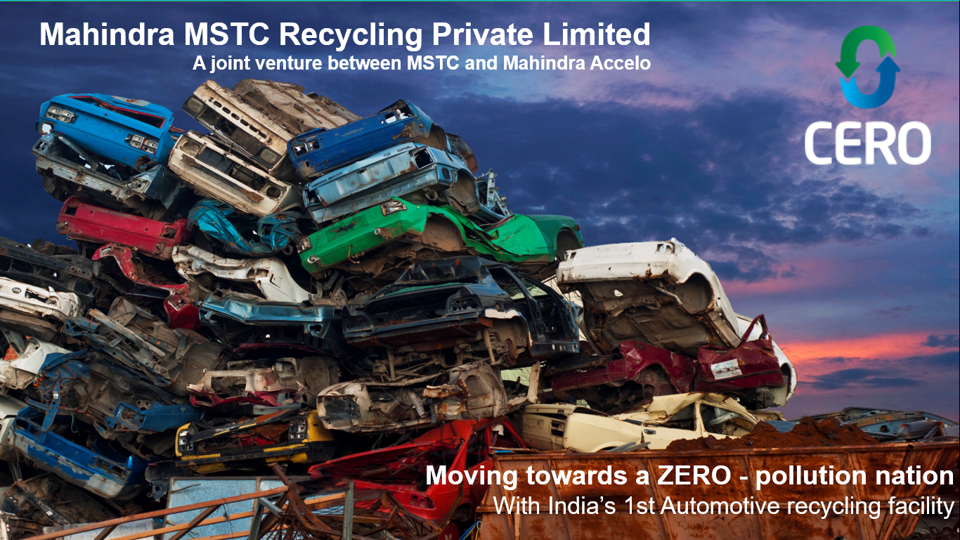
    We have set up India’s first state-of-the-art facility at Greater Noida for de-polluting, dismantling, bailing and shearing end-of-life vehicles (ELVs). We operate with an objective of zero tolerance towards unscientific methods of treating ELVs. We have the capability to recycle cars, trucks and buses, 2-wheelers and industrial scrap. We are shortly starting operations at our second collection-cum-dismantling centre at Chennai and will be opening 3 more centres this year.

    3. What are your views on implementation of the ‘Vehicle Recycling Policy’? By when do you feel it’s impact is likely to be felt?

    The Vehicle Recycling Policy, which would make scrapping of end-of-life vehicles mandatory, will have its impact in a big way. The impact would be visible once the policy is in place, but one needs to keep in mind that there exists an elaborate unorganised sector that has grown and become an established system in the country. It will take considerable time for the mind-set to change and an organised recycling industry to become effective.

    4. What is the progress at the other 3 auto recycling facilities which were planned earlier across India? What are the other future initiatives in the pipeline?

    We are starting our operations in Chennai by the end of this quarter. Post-that, we will set up 4 more facilities at Bengaluru, Kolkata, Mumbai/Pune and Hyderabad. We plan to be present in 25 locations in the next 2-3 years, covering all major catchment areas. ELV shredding is also planned and will come up as soon as we have more clarity on the policy.

    5. A few other major companies in India are also eyeing an entry into the recycling space. How is Mahindra likely to withstand this competition?

    Setting up state-of-the art recycling infrastructure pan-India and inclusion of the informal sector within CERO will be Mahindra’s differentiating factor. We would focus on our USPs of utilizing latest recycling technology, developing partnerships with all stakeholders and providing hassle-free process for our customers in scrapping their vehicles by strictly following environmental norms during the process.

    6. How much steel scrap is expected to be generated domestically and how much scrap will India import once these shredding plants come into operation?

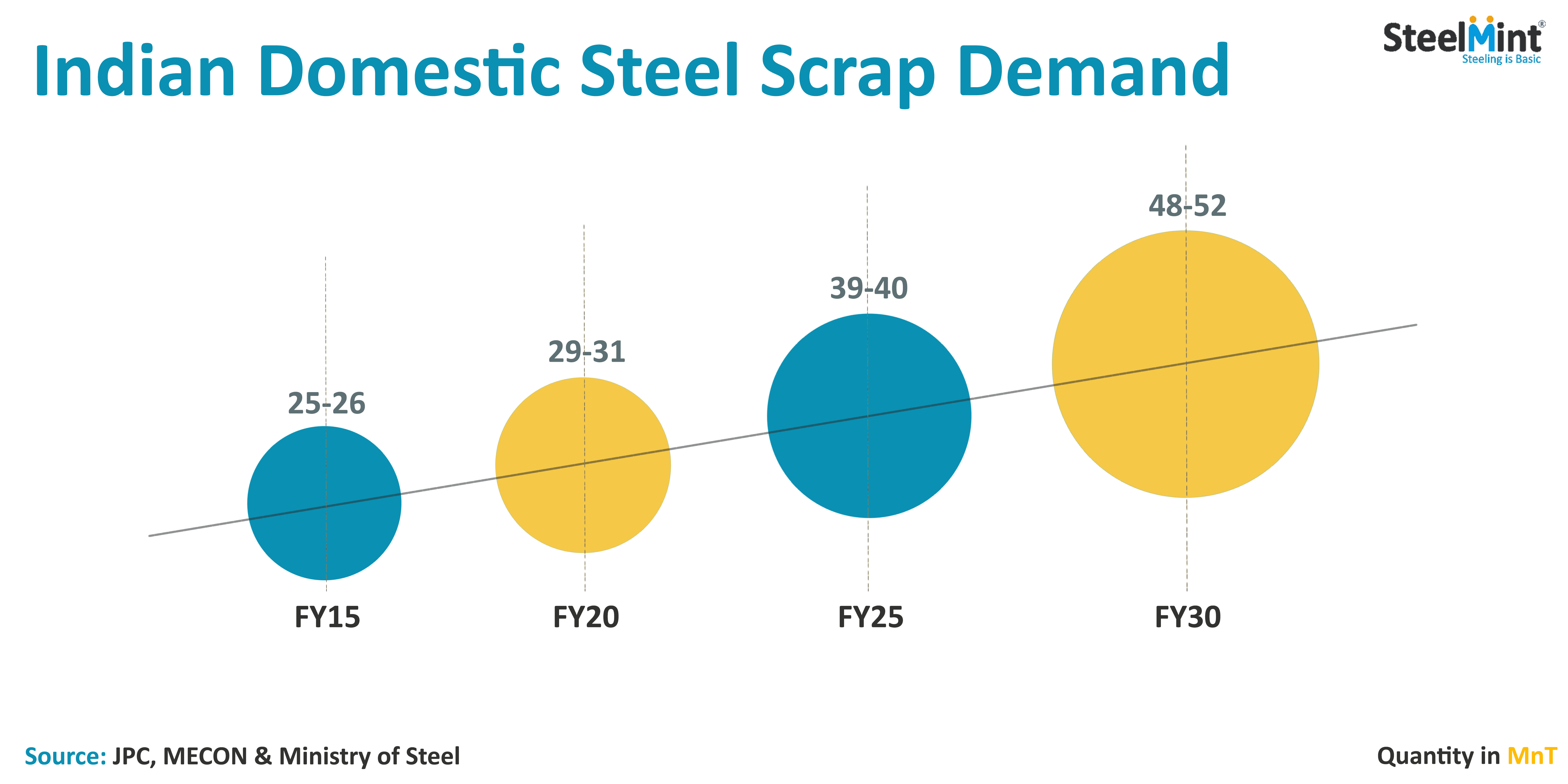
    In 2015, India’s domestic demand for steel scrap was about 26 million tonnes (MnT) while domestic supply was about 19-20 tonnes (MT), leading to imports of about 7-8 MnT. By 2030, this demand is expected to grow to 45-50 MnT. Production of steel scrap domestically will help in reducing India’s dependence on steel scrap imports, thereby saving the country’s precious foreign exchange reserves.

    7. What are the challenges this industry is facing and how can these be fixed from your point of view?

    All the stakeholders need to play some role for this industry to prosper. Currently, ELV owners are not aware of the ill-effects of running their old vehicle. Those who want to scrap it, do not have proper channels to do so. We have issues of lack of rules and regulations pertaining to deregistration, GST etc. A government policy that makes scrapping of vehicles mandatory and provides tax incentives or investment promotion subsidies will help formalise this sector. Secondly, following best practices of European and other developed countries of formulating an Extended Producer Responsibility (EPR) for the original equipment manufacturers (OEMs), which will also help as they will be then integrated into the ecosystem

    In order to know more about India’s vehicle recycling, book your seat at SteelMint’s 4th Steel Scrap, Billet & DRI Trade Summit and get a chance to hear insights from Mr. Vijay Arora. The conference is being organised during 27-29th August, 2019 in Bangkok, Thailand.

    Know More

  • Indian Domestic Scrap Demand Likely to Double by 2030, Reveals Govt Policy

    Indian Domestic Scrap Demand Likely to Double by 2030, Reveals Govt Policy

    The Ministry of Steel has prepared a draft steel scrap policy, envisaging a framework to facilitate and promote the establishment of ferrous scrap/steel scrapping centres in India. Availability of right quality of scrap, in adequate quantity, is one of the critical factors for future growth of both the EAF/IF sectors and keeping this objective in view and in order to develop a globally competitive steel industry by adopting a state-of-the-art environment-friendly technologies, the ministry has come up with the much-awaited draft policy. All stakeholders are requested to submit comments latest by 14th July, 2019.

    While iron ore remains the primary source of steel making, used or re-used steel in the form of scrap is the secondary raw material for the steel industry. As on March 2019, 1128 EAFs & IFs are operating in the country and largely depend upon scrap as a raw material to produce steel. The use of every tonne of scrap shall save 1.1 tonnes of iron ore, 630 kg of coking coal and 55 kg of limestone, it added.

    Why is there a need for the policy?

    The availability of scrap is a major issue in India and in 2017 the deficit was to the tune of 7 million tons (MnT). The gap between demand and supply is likely to be reduced in the future and the country may be self-sufficient by 2030.

    The efficient use of scrap for steel production becomes very crucial for India as 35-40% share has been envisaged from scrap-based steel production in the journey of 300 million TPA by 2030. This shall increase requirement of steel scrap from the present level of around 25 MnT to more than 50 MnT by 2030. This is mainly because with the increase in consumption of steel in the recent past and ELVs, the generation of scrap is likely to be increased considerably. This scrap has to be channelized so that the same can be utilized for steel production in an environmental-friendly manner.

    What are the objectives of the Indian steel scrap policy?

    · To promote circular economy in the steel sector

    · Processing and recycling of products in an organized, safe and environment-friendly manner.

    · To produce high quality ferrous scrap for quality steel production, thus minimizing the dependency on imports.

    · To decongest the Indian cities from ELVs and reuse of ferrous scrap.

    · To create a mechanism for treating waste streams and residues produced from dismantling and shredding facilities in compliance with the Hazardous & Other Wastes (Management &Transboundary Movement) Rules, 2016 issued by MoEF&CC.

    · To promote 6Rs principles of Reduce, Reuse, Recycle, Recover, Redesign and Remanufacture through scientific handling, processing and disposal of all types of recyclable scraps, including non-ferrous scraps, through authorized centres /facilities.

    How will the working model be?

    The increased production of vehicles and increased use of consumer durable and white goods in the last two decades and their rapid obsolescence shall generate large quantities of end-of-life products. This shall result in the generation of a continuous flow of large ferrous scrap for recycling in steel production.

    The collection and/or dismantling centre should either set up by or be associated with a scrap processing centre.

    Logistics may be one of the main challenges for safe and cost-effective transport system for inbound unprocessed products/scrap and outbound processed scraps to the melting shops. Thus, scrapping centres (collection-cum-dismantling centre and recycling centre) need to be supported by an adequate logistic facility in consonance with the National Logistic Policy.

    In order to know more on Indian steel scrap demand-supply scenario, domestic generation & imports, book your seat at SteelMint’s 4th Steel Scrap, Billet & DRI Trade Summit being organised during 27-29th August, 2019 in Bangkok, Thailand.
    Know More

  • Mughal Steel to Raise Output, Eyes Infrastructure Growth

    Mughal Steel to Raise Output, Eyes Infrastructure Growth

    Mughal Iron & Steel Industries Ltd. is Pakistan’s largest steel producer and perhaps the largest importer of scrap as well. From a modest beginning as a trading company in 1950, it moved to steel production and today it plays a significant role in the region’s economic development. One of the people at its helm is Mr Fahad Javaid Mughal, a director in the company, who holds a bachelor’s degree in international business from Australian National University, Australia.

    Here follows excerpts from a telephonic interview with Mr Mughal:

    1. How is the global steel scrap market looking this year?

    The US halved its 50% tariff on Turkish steel imports this month and the market spiked up instantly. But I’m thinking, demand is not going to stay very high for Turkish steel because I see US fulfilling its demand for steel domestically and it might take some time for Turkey to establish itself in the US market after a lull.

    2. What is your price forecast for steel scrap?

    I see prices in Pakistan under $330-335/tonne, CFR, in the next few months as against $320-325/tonne at present. Currently, Turkish scrap prices have been at $295-297/tonne on average, though variations do occur because of demand. However, I can see Turkish scrap rates staying over $290/tonne, CFR. Turkish rebars are seen around $490/tonne. Pakistan’s buying price is approximately $25-30/ tonne higher than that of Turkey due to freight.

    3. How is the local market for steel doing in Pakistan?

    Demand in Pakistan might rise in two month’s time as the government is to release funds for some projects. There could be an upward impact on prices to the extent of $10-15/tonne. Turkey may start buying aggressively and that might also have an impact on prices. Once US starts to to buy, the market dynamics will change.

    4. How are the China Pakistan Economic Corridor (CPEC) and Silk Road projects shaping up? How much of a boost will these projects mean for Pakistan’s steel producers?

    The premier of both China and Pakistan had a meeting recently and we are expecting new tenders for the projects. Four new MoUs were signed. The new tenders would be modified tenders. Demand is expected to arise by the end of this year. The local industry is working along with CPEC even though it is not supporting all the steel mills. It depends on the brand and prices.

    5. How is the demand for steel in Pakistan’s home market?

    At present, the per capita consumption of long-rolled steel products in Pakistan is 24kg which is the lowest in the Asia-Pacific region. Our neighbouring country, India, has per capita consumption of long-rolled steel products of 50kg. So in the coming years, Pakistan steel market will definitely grow and our expectation is that the per capita consumption will increase to 35kg. Demand from commercial and home sectors are doing good. Now government has to allocate a good amount of funds for new projects like dams, flyovers, motorways and others. As per the new budget announced in June, Government has imposed a Federal Excise Duty of 17% and abolished special sale tax procedures on scrap and billet import. This is favourable for the steel industry as a whole, as tax net will expand and it will make a level playing field for all the manufacturers in steel sector.

    6. How is the Pakistani government protecting the industry from the onslaught of Chinese exports?

    There is protection. For instance, there is a 43% tariff on rebars especially from China. Steel industry is happy and has invested in furnaces.

    7. How much steel will Pakistan produce in 2019-20?

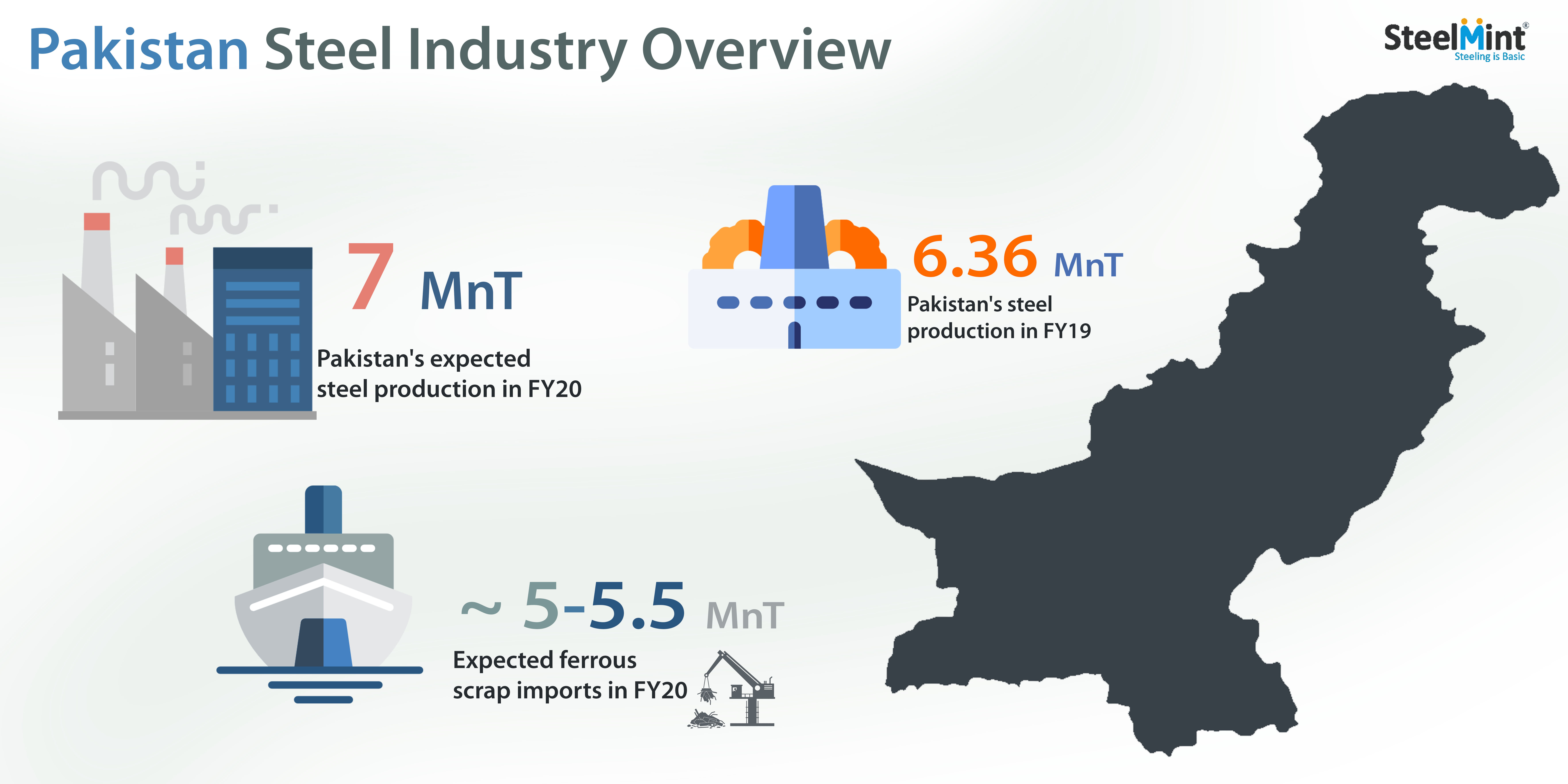
    Pakistan is expected to produce 7 MnT of all steel products this year. In 2017-18, Pakistan produced 7 MnT of steel, but in 2018-19, it fell by 9.2% owing to the depreciation of the local currency. Pakistan’s rupee depreciated by 40%, scrap prices went up and duties also went up. The industry could not pass on the cost to the customer. From 2020 onwards, we expect a steady rise from current levels.

    8. What are the expansion plans of Mughal Iron & Steel Industries?
    We are the largest producers of steel in Pakistan with a capacity of 0.7MnT. In another two months our capacity will rise to 1.1 MnT. We also have a 60 megawatt coal-based power plant coming up which is expected to be ready in one and half to two years from now.

    9. How much of steel scrap will Pakistan buy this year (2019-2020)?

    Pakistan will buy tentatively 5 MnT of steel scrap this year, but this can further increase if the upcoming steel capacities become operational in 2019-20.

    In order to know more on Pakistan steel and scrap trade markets, book your seat at SteelMint’s 4th Steel Scrap, Billet & DRI Trade Summit. The conference is being organized during 27-29’th Aug’19 in Bangkok, Thailand.

    ~ Inputs by Ruchira Singh

    Know More

  • How Are Steel Markets Aligned For 2020?

    How Are Steel Markets Aligned For 2020?

    The Global events have continued to affect Price dynamics of Steel Industry in 2019. There prevails turbulence and uncertainty as we face the big question of how will the market pan out in 2020?

    Amidst Trade Wars caused by US Protectionism and High imports tariff has compelled China to seek new markets, increasing its Steel Exports. This coupled with China’s oversupply has naturally bothered other major markets and they wary about China Flooding the Steel Markets in 2020?

    Iran also is coerced by US sanctions to sell its Billet Cargos at discounted prices altering the dynamics of Billet Markets.

    In the other part of the world, Emerging Markets of South and South East Asia (Bangladesh, India, Indonesia, Pakistan & Vietnam) have increased their sea-borne scrap imports manifolds in the last few years. This has created new and encouraging opportunities for suppliers across the globe. This potentially might put Asia as the new benchmark for sea-borne scrap.

    Iron-ore prices are on a 5 year high after the tragic Vale dam collapse in Brazil facilitating many buyers to take the steel scrap route of Steel-making.

    China’s emissions standards tightening further in 2017 led to hundreds of smaller mills to shut under stricter enforcement. This invited a sudden traction in EAF route of steel-making that in-turn catapulted the Graphite Electrode prices, GE being the essential raw material involved in there which has no other substitute. Just as the prices seem to be normalizing now, China increased its GE production further that instills some fear in GE producers if this act could further pull down the prices of Graphite Electrode and upset the global markets, yet again.

    There’s a lot that will be discussed and deliberated upon by the Global Buyers, Suppliers, Steel Mills, GE Producers & Analysts who are gearing up to attend the 4th Steel Scrap, Billet and DRI Trade Summit alongside the 2nd Global Graphite Electrode Conference by SteelMint Events. The conference is scheduled to be organized during 27-29th Aug 2019 at Hotel Avani Riverside, Bangkok

    Know More

  • Tata Steel Thailand Plans to Ramp Up Steel Capacity Utilization – Mr. Rajiv Mangal

    Tata Steel Thailand Plans to Ramp Up Steel Capacity Utilization – Mr. Rajiv Mangal

    Tata Steel – Thailand is one of the renowned names in manufacturing of long steel products. SteelMint in interaction with Mr. Rajiv Mangal, President & CEO of Tata Steel (Thailand) Public Company Limited learned about his views on ramp up plans of the company and expected increase in country’s crude steel production in the coming years. Below are the edited excerpts from the interview

    1. Has Thailand steel industry poised for growth, what is the future outlook?

    Unlike other countries in ASEAN region where dependence of steel sector on construction is very high (>75%), Thailand’s steel consuming sectors are diverse. Total apparent finished goods steel consumption in the country was 17.4 MnT in 2018, up by 4.8% Y-o-Y. This translates to approx. 263 kg per capita of steel consumption. Construction, Machine & Appliances and Automobiles sectors consumed 55%, 21% and 19% shares of the total steel consumed in 2018 respectively.

    As per Iron & Steel Institute of Thailand (ISIT), steel consumption in 2019 is likely to be around 19 MnT , an increase of approx. 8% in 2018. Personally, I feel growth will be in the range of 4-6% on account of continuing trade frictions in international arena and political uncertainty in the country after the general elections in March 2019.

    2018 witnessed a Y-o-Y increase in automobile, cement and canned seafood production by 8.9%, 1.2% and 13.6% respectively. With the first car policy after effects almost gone and huge infrastructure development plans announced for next five years by the Thai Govt, steel consumption is expected to witness healthy growth coming years.

    There are roughly 20 crude steel-making facilities in Thailand, nearly all of which use electric arc furnace technology to produce steel. In comparison, over 150 hot-rolling, cold rolling, cold-drawing, and coating mills are in operation in Thailand which relies heavily on imports of semi-finished and finished steel products for their manufacturing inputs.

    2. Is steel capacity utilization low in Thailand?

    In 2018, Thailand imported 15.2 MnT of steel, an 8 percent increase from 14.2 MnT in 2017. At the same time, domestic production was approx. 7.1 MnT with average capacity utilization below 50%. This is not good for the financial health of the domestic steel industry. One of the major reason for low capacity utilization in Thailand is that 100% steel production is based on secondary route of steel making. This makes the cost of steel produced locally higher than primary route steel manufactured in major steel producing countries like China, Japan and Korea. At the same time, most of the steel made in the country is in upstream and commodity by nature. With new blast furnace based capacities coming on stream in Vietnam and Malaysia in last one year, challenge for Thai steel producers have aggravated. Need of the hour is consolidation and shifting up in the value chain.

    3. What are the measures being taken by Tata Steel Thailand to increase production and demand from local mills and how is the scenario after HBIS take over?

    Tata Steel Thailand has a rated capacity of 1.7 MnT pa of long products spread across three manufacturing sites in Thailand. By virtue of better product mix, pan Thailand reach and sale of branded products, average capacity utilization of the company is in the range of 70-75%. This is much higher than country’s average. Exports account for 10-12% of the total sales. During 2011-16, Thailand saw widespread dumping of wire rods from China. With structural changes in Chinese steel industry and Thai Govt imposing tariff and non-tariff measures, imports from China has come down in last 2 years.

    In coming years, Tata Steel Thailand plans to enhance capacity utilization beyond 80-85% by increasing sale of high end wire rods suitable for auto sector, ready to use Cut & Bend products and high strengthRebars for construction companies. With strong brand presence in Laos, Cambodia and Myanmar, exports to these countries is also poised to go up.

    The share purchase agreement signed with HBIS in end Jan’19 is not yet closed.

    4. Do you see steel scrap imports rising in coming years in Thailand, what is your forecast?

    As scrap remains the primary raw material for steelmaking in Thailand, its consumption is bound to increase in line with steel production increase in coming years. At the same time, domestic steel industry has taken up with the Govt to promote exports of value added products and discourage export of scarce raw material like steel scrap. Another factor to be closely tracked is increase in steel production & consumption in Vietnam and Malaysia from the new investments in last 2-3 years. If these countries resort to aggressive exports, Thailand may witness increased imports of semis and finished products. Thus rate of change in import of scrap in Thailand will depend upon policy for prevention of scrap exports and imports of semis and finished steel from neighboring countries.

    To know more on scrap industry in emerging markets, book your seat at SteelMint’s 4th Steel Scrap, Billet & DRI Summit. The conference is being organized during 27-29’th Aug’19 in Bangkok, Thailand.
    ~ Inputs by Dr. Sheena Abraham

    Know More