SteelMint Events

Category: Blog

  • Indian Govt Issues Directive on Environmental Clearance, Will India See a Major Iron Ore Disruption?

    Indian Govt Issues Directive on Environmental Clearance, Will India See a Major Iron Ore Disruption?

    Odisha govt finds fresh EC (Environmental Clearance) directive unacceptable. Miners feel transition delay will be only of six months

    A new directive, issued on November 29, by the Union Ministry of Mines, seems to have whipped up a controversy. As per the new proposals, successful bidders in the upcoming mineral auctions will have to apply for fresh environmental clearances (ECs) against the earlier anticipation that the same would be extended for two years. While on the one hand, Odisha is bracing to seek modifications in the new proposals, merchant and captive miners do not seem too perturbed, saying the delay in the transition process will not be anything to write home about. The new lessee has to apply afresh to the environmental advisory committee (EAC) of the Ministry of Environment & Forests (MoEF).

    Unacceptable to Odisha Govt.

    Speaking to SteelMint, a high ranking official at ministry of mines, Odisha, said that the state had “reservations” on this new November 29 directive. He said, a Union Ministry of Mines meeting has been slated on December 10, which he will be attending, and where he intends to take up some of the key issues.

    He said: “We feel the existing EC should be made valid for at least another two years so that the new successful bidder can immediately take up the lease operations. The new directive is not acceptable to us. We had sought extension of the present EC validity for at least two years, in the name of the new lessee. The present directive does not indicate that. Nothing has been said on that.”

    He further said: “We will put forward our points and then let us see if the government can clarify, make some modifications in the proposals. Our key point is that the new bidder has to be supported in taking up operations immediately after the expiry of the lease. The present directive does not support that because of the fresh EC hurdle. “

    He emphasised that there is another point on which he needs clarity. “…The application shall be appraised accordingly for grant of environmental clearance subject to the same validity period as was initially granted…”

    Speaking on the above point, official said: “I do not know what the environmental advisory committee (EAC) of the ministry would mean here because all the leases expire by March 2020.”

    Officials in the Odisha state government indicated that earlier there was a consensus between state and Centre that the EC will be extended for a period of two years but after this notification, successful bidders have to apply for an EC, which will go through a process of due diligence. Even if the government works efficiently, it will take at least six months to get the new EC cleared (against a normal period of two years).”

    EIMP, public hearing exemptions

    Sources in leading merchant miners say they do not think there will be a huge delay because the government, under the new proposals, has exempted the new bidder from preparing a new environmental impact assessment (EIA) study and environmental impact management plan (EIMP), “which takes up a lot of time” along with the public hearing.

    But, importantly, the new successful bidder has to continue working with the same production capacity of the previous lessee. He cannot increase from the existing production volume.

    The EIMP has to cover a monsoon and a summer season study which a lessee has to submit along with the EC application. The lessee has to give the two-season study of the mine area and the periphery, which takes almost one year. Then the report is prepared. Subsequently, the bidder has to submit the study along with the application. This entire process takes more than a year.

    However, under the new directive, the new bidder has to apply afresh and the old EIMP cleared by the earlier lessee will be considered by the committee, in what is being regarded as a big plus-point.

    Another aspect that has been exempted is the public hearing. The State Pollution Control Board organises and conducts the public hearing. This report is then submitted to the EAC of the MoEF. The entire process takes six months to get completed.

    In fact, there is a two-stage process to the EC application. First the bidder has to apply for the terms of reference (TOR). Then the public hearing and EIMP reports are taken into consideration. “The two stages of the EC application process normally take one-and-a-half to two years,” reiterated an industry source.

    “The time taken to issue an EC is actually because of these two aspects, the EIMP and the public hearing,” added the source.

    But the exemption for both is applicable only when the mines are put to auction and a new successful bidder comes in, and takes over the existing mine.

    Possible delay of six months

    When asked about the most worrisome aspect – whether the new directive would delay resumption of mining operations after the new lessee takes over, sources feel there is really nothing to be concerned about. A source said there will definitely be a lapse between the time the new lessee takes over and production resumes, because there will be discontinuation of mining operations till the new EC is in place. “The new bidder will not immediately be able to start mining until he gets the new EC.

    But he added that since the hurdle of a new EIMP and public hearing are being dispensed with, it will take 2-3 months for a fresh EC to be issued and six months at best on the higher side from the time of the application, instead of the usual one-and-a-half to two years,” reasoned the source..

    “So, the transition will not be delayed too much since it will only entail the process of applying for the new EC and making a presentation before the MoEF EAC. This committee takes the hearing and recommends to the government whether the EC should be granted or not,” explained another source.

    Importantly, if the new bidder subsequently wants to increase production further than the previous lessee’s volume, then he has to undergo the old process – apply afresh, go through the public hearing and prepare a fresh EIA and EIMP and present the same before the committee.

    Corroborating, a source from a large steel company which is also a participant, said: “For a 2020 expiring mine having EC (after 2006), the new lessee would be able to get fresh clearances easily provided the production plan is within the EC limit of earlier lessee.”

    The source added that only after “filling a Form 1, clearances would be given… So, there will be ease for new lessees after winning in the auctions, provided they do not increase their production target.”

    Will India See a Major Iron Ore Disruption?

    To learn how the mines auction 2020 unfolds, be a part of SteelMint Events’ 4th Indian Iron ore, Pellet and DRI Summit‘ which is scheduled on 2-3 March 2020, in Hotel LaLiT, New Delhi.

  • Bangladesh Observes Sharp Decline in Import of Scrapped Ships in Q3 2019

    Bangladesh Observes Sharp Decline in Import of Scrapped Ships in Q3 2019

    Bangladesh is one of the largest ship-breaking and recycling hubs in the world, which forms an important source of ferrous scrap to the country’s increasingly scrap-dependent steel industry. Bangladesh is on a course of surpassing India to become the country with the largest number of used ships imported in CY 2019.

    However in Q3’2019, the country witnessed a sudden slump in its imports of scrapped ships.

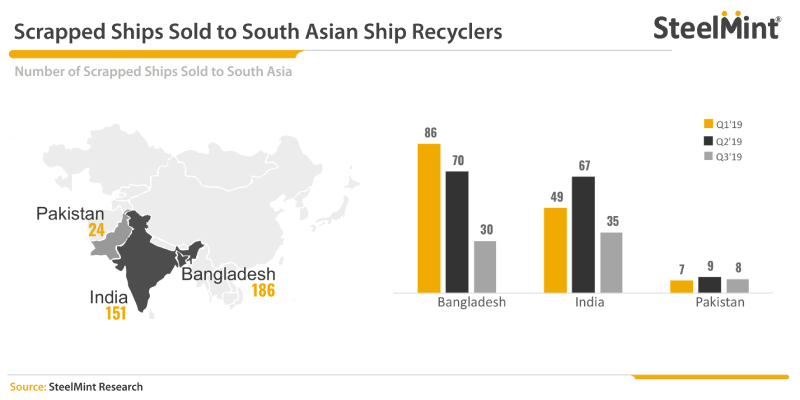
    The number of scrapped vessels imported to Bangladesh for ship-breaking and scrap generation, witnessed a significant fall of 57% Q-o-Q in Q3 CY’2019 with just 30 vessels being imported in the quarter, as against 70 vessels imported in Q2 CY’19, as per data released by NGO Shipping platform. Notably, in Q1’2019, the number of vessels imported stood at 86, the highest quarterly figure as yet.

    The major reasons attributed to the sharp fall in vessel import numbers in Q3 are the new taxes imposed in Bangladesh’s annual budget implemented from July’19, as well as the oversupply in the surplus imports in the preceding quarters. An additional VAT at a specific rate of BDT 1000/Tonne was imposed on import of scrap ships after the implementation of the budget, a change from the initial proposal of the budget in Jun’19, which had  proposed a 5% VAT on the value.

    In anticipation of the tax alterations in this year’s budget, most of the ship-breaking yards in the country had booked scrap vessels in excess, in the preceding Q1 and Q2’19. The surplus scrapped ships after being processed created an oversupply in the local scrap market of Chittagong which lasted for around 3-4 months, thus discouraging recyclers from importing further vessels, amid huge quantities of unsold inventories of scrap.

    The said over supply in the market also pulled down the ship yard scrap prices in the domestic market, with offers for local ship yard scrap, falling from BDT 37,000/MT to 29,000/MT ex Chittagong, within a span of just 3 months in the quarter.

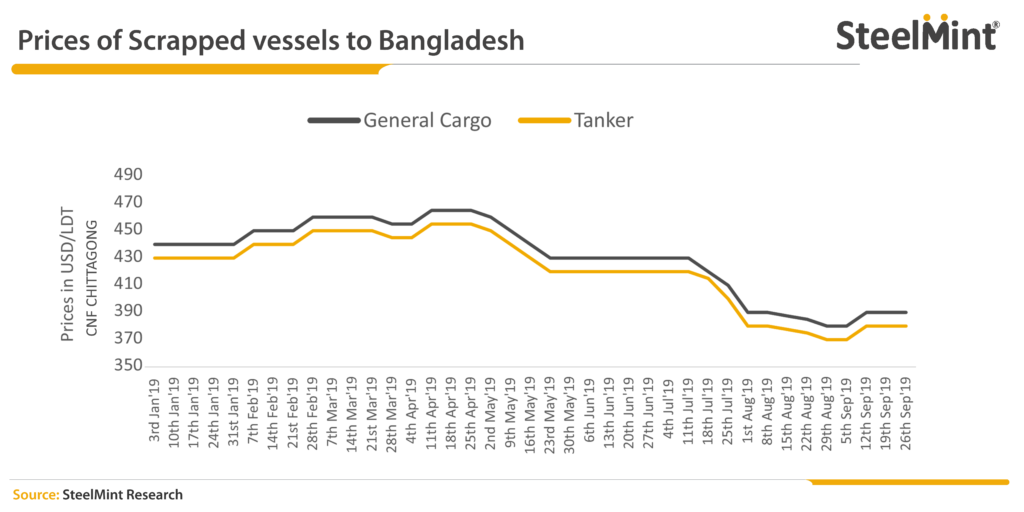
    The severely weakened demand for import of scrapped vessels from a major buyer like Bangladesh led to a continuous fall in its prices, with the offers for Tanker vessels sharply declining from USD 420/LDT CFR Chittagong in the beginning of Q3’19 to around USD 370/LDT CFR by Sep’19.

    On the other hand, for the period of Jan-Sep 2019, Bangladesh has considerably improved against other South Asian markets in terms of number of scrapped vessels imported and even surpassing India for the 1st time. From Jan to Sep’19, Bangladesh imported 186 scrapped vessels, against 151 vessels imported by India, while Pakistan remained at 3rd with just 24 vessels imported till Sep’19.

    In 2018 (Jan-Sep’18) Bangladesh had lagged behind India with 124 scrap vessels being imported during this period, as compared to 195 vessels imported by India. However, even with a significantly lesser number of vessels imported, Bangladesh had surpassed India in terms of total volume of scrapped ships imported, as the country’s volume for imports of scrapped vessels stood at 1.79 Million LDT in Jan-Sep’18, as against 1.46 Million LDT for India, thus indication that Bangladesh imported larger scrapped vessels on an average for recycling.

    To know more about ship recycling industry in Bangladesh book your seat at SteelMint’s 3rd Steel and Raw Material Conference, Bangladesh and get a chance to hear views of renowned industry participants from across the globe. The conference is being organized on 23rd-24th March 2020 in Chittagong, Bangladesh.

    Explore

  • Bangladesh Coal Imports Hit All-Time High in Oct’19 – CoalMint

    Bangladesh Coal Imports Hit All-Time High in Oct’19 – CoalMint

    Domestic coal supplies in Bangladesh has been under scrutiny ever since government’s decision to halt coal sales to the local industries was imposed back in Mar’18, which have paved way for subsequent higher coal imports.

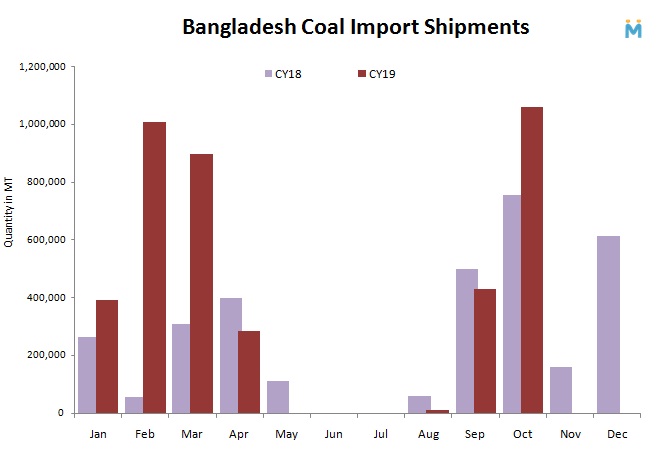
    Incidentally, Coal Shipments taken by the country have recorded a mammoth total during Oct’19, thereby helping the country to overtake the total imports registered in CY18.

    Data compiled by CoalMint research indicates that Bangladesh coal imports had attained its highest-ever total since the period from which vessel line-up information for the country was started.

    Coal Intake in Oct’19 was recorded at 1,061,867 MT rising 148% on the month from 428,585 MT in Sep’19.

    Bangladesh had made a slow start post monsoon, wherein after recording nil imports during May-Jul’19 only 10,000 MT coal was bought in the month of Aug’19. However, the exponential monthly rise in Sep’19 was subsequently followed by relatively superior imports in Oct’19, thereby helping the country to overtake the coal volume acquired in CY18 with two months to spare.

    In the first 10 months of CY19 (Jan-Oct’19), Bangladesh coal imports have reached 4,084,475 MT which was 28% higher than 3,220,882 MT noted in the whole period of CY18.

    There has been no sign of immediate resumption of coal supplies asserted by the latest updates provided by Barapukuria Coal Mining Company. Notably, whole 659.75 MT coal produced under its belt was solely delivered to the coal based station operated by Bangladesh Power Development Board (BPDB) as on 13 Nov’19, thus continuing the trend being followed after the ban was imposed.

    Major Coal Suppliers:

    The record import volume in Oct’19 was majorly catered from Indonesia, which remained Bangladesh’s preferred source for coal demand. Supplies from Indonesia rose 46% M-o-M to 624,690 MT in Oct’19, which was also marked 6% higher on the year from 590,450 MT in Oct’18.

    Coal receipt from South Africa also recorded its highest-ever monthly total in Oct’19, noted at 375,216 MT. Apparently, coal shipment from the country was seen after a gap of 6 months.

    Besides, first coal shipment from Mozambique in CY19 was also reported in October, which had supplied the remaining coal volume during the month.

    Country Oct’19 Sep’19 % Change
    Indonesia 624,690 428,585 46%
    South Africa 375,216
    Mozambique 61,961
    Grand Total 1,061,867 428,585 148%

    Source: CoalMint Research
    Quantity in MT

    Although, major portion of the coal imports are utilized by country’s brick manufacturers, coal demand in Bangladesh is expected to be supported by a series of coal-fired power stations slated to come online in the coming years.

  • Bangladesh to Add 17,304 MW Power Capacity to Meet its Energy Requirement

    Bangladesh to Add 17,304 MW Power Capacity to Meet its Energy Requirement

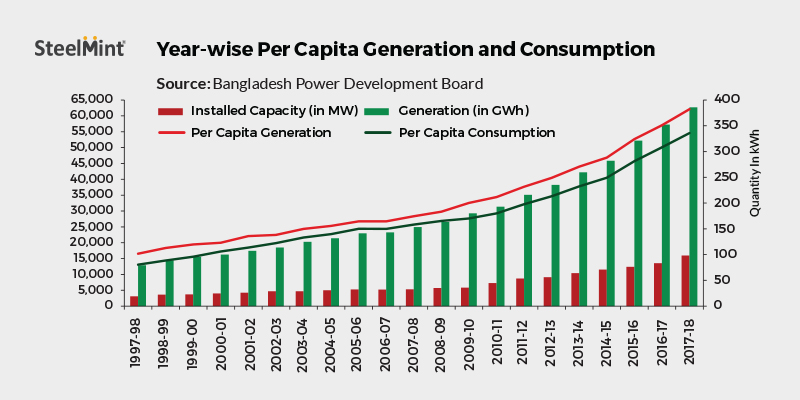
    In order to mitigate the demand-supply gap, Bangladesh has planned a massive expansion in power sector to cater its rising electricity demand. The road-map prepared by the government envisage around 17,304 MW new generation capacity addition by 2023.

    Incidentally, power sector is one of the booming sectors in the country, wherein largest energy consumers are residential sector, followed by industries, commercial and agricultural sectors.

    Out of the total capacity addition, 9,393 MW power units would be installed under public sector, followed by another 6,075 MW in private sector power plants, as depicted under the revised expansion plan updated in Jul’19. Remaining 1,836 MW would be catered by imports.

    For a longer run, the country has formulated a systematic expansion for growth in power sector, under the Power System Master Plan (PSMP) 2016. The underlying plan compiled for a period running from 2016 to 2041, also includes strategy for diversifying primary fuel supply.

    PSMP 2016 indicates that generation capacity requirement in 2021 would be 21,000 MW against the demand of 14,500 MW, in 2030 capacity requirement would increase to 31,000 MW against the demand of 27,400 MW and by the end of 2041 it would rise to 57,000 MW against the demand of 51,000 MW.

    At present, power generation from gas based plants is comparatively much higher than other fuels, which often fail to reach their usual capacity due to shortage of gas supply. Consequently, the country has taken up the decision to diversify primary source of fuel in order to reduce dependency on gas based power generation.

    By the end of 2041, Bangladesh is aiming to raise share of coal fired power generation to 35% at the expense of gas based generation which would be brought down to 35%. Remaining share accounted to power imports and generation from nuclear and renewable sources.

    Power Plant Performance in FY19

    Bangladesh’s power generation capacity has increased to 18,961 MW by the end of Bangladeshi fiscal year 2018-19 (Jul’18-Jun’19), recording an annual increment of 18.86% Y-o-Y.

    Despite claims of reducing dependency on gas based power, largest capacity addition was seen in power plants running on gas.

    Apparently, no capacities were added under coal based power station, thereby further reducing its share in total installed capacity. The country is, however, set to begin operation at its first imported coal based power plant in Jan’20 with the commissioning of Payra plant having an installed capacity of 1320 MW.

    Source FY19 FY18
    Installed Capacity % Share in Total Installed Capacity % Share in Total
    Gas 10877 57.37% 9713 60.89%
    Furnace Oil 4770 25.16% 3443 21.58%
    Diesel 1370 7.23% 1380 8.65%
    Power Import 1160 6.12% 660 4.14%
    Coal 524 2.76% 524 3.28%
    Hydro 230 1.21% 230 1.44%
    Solar PV 30 0.16% 3 0.02%
    Total 18961 100% 15953 100%

    Source: Bangladesh Power Development Board
    Quantity in MW

  • China-Funded Mega Power Plant Set to Strengthen Bangladesh’s Power Generation Capacity

    China-Funded Mega Power Plant Set to Strengthen Bangladesh’s Power Generation Capacity

    Bangladesh’s newly-constructed first unit of Payra coal-fired power plant has been completed and is scheduled to start commercial operation in December this year.

    We have a target to add 660 MW electricity from the first phase of 1,320 MW Payra power plant to the national grid from December 31 this year,” stated the country’s State Minister for Power, Energy and Mineral Resources Nasrul Hamid.

    “With the generation of 660 MW, the country’s power generation capacity will stand at 23,222 MW,” he added.

    The Payra Power Plant, located at Kalapara upazila in Patuakhali district of southern Bangladesh, consists of two 660MW ultra-supercritical coal-fired power generating units. Construction on the project started in late December 2017 at an estimated cost of USD 2 billion.

    Upon completion, the power plant will be operated by Bangladesh-China Power Company Limited (BCPCL), a joint venture firm of the Bangladeshi state-owned North-West Power Generation Company Limited (NWPGCL) and China National Machinery Import and Export Corporation (CMC).

    Notably, Bangladesh has at least 29 coal-fired power projects with a total capacity of 33,200 MW in pre-construction and under construction phases as of July this year.

    In addition to UK- and Japan-based companies, Chinese banks and companies are the leading driving force behind the planned coal-based power projects in Bangladesh.

    At present, the 525 MW Barapukuria subcritical plant in Dinajpur district is the only operational coal-fired plant in Bangladesh.

    Most of the proposed coal projects plan to use imported coal for power generation. Deep sea ports planned at Payra in Patuakhali district and Matarbari in Cox’s Bazar district would be required to import coal from Australia, India, Indonesia, and South Africa.